Startup Verticals vs. Horizontal: When Each Wins
Startup Verticals vs. Horizontal: Quick Definitions
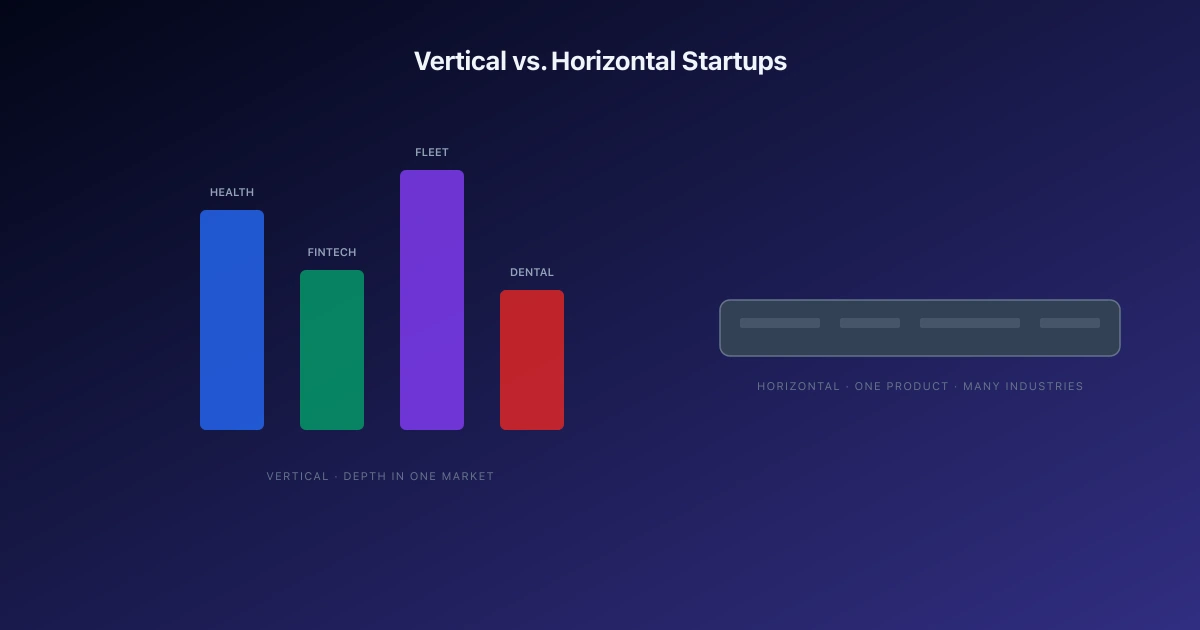
If you searched "startup verticals," "vertical startup," or "vertical start up meaning," you are comparing two positioning strategies:
- Vertical startup: Builds for one industry or buyer type with workflow depth (e.g. AI credentialing for hospitals, neobanking for fleets).
- Horizontal startup: Sells the same core product across many industries (e.g. email, cloud hosting, generic CRM, developer APIs).
- Platform: Often horizontal infrastructure that vertical apps sit on top of (payments rails, LLM APIs, data warehouses).
Neither label describes technology alone. "We use AI" is not a vertical; "AI for ambulance billing" is. For foundational terminology, see what are industry verticals; this article goes deeper on when to pick vertical vs. horizontal and how YC companies illustrate the tradeoff.
Side-by-Side Comparison
| Dimension | Vertical startup | Horizontal startup |
|---|---|---|
| Initial market size | Smaller, well-defined niche | Larger, fragmented TAM |
| Product depth | Industry workflows, compliance, jargon | General workflows reusable everywhere |
| Sales motion | Associations, vertical events, specialist buyers | PLG, broad outbound, platform partnerships |
| Competition | Legacy vendors, spreadsheets, vertical incumbents | Many SaaS peers, platform giants |
| Pricing power | Higher when you replace critical ops software | Often race to usage-based or seat compression |
| Expansion path | Adjacent workflows in same vertical, then sometimes horizontal modules | New vertical editions or upmarket enterprise features |
| Investor narrative | Category leader in a wedge market | Platform scale, network effects, infra moat |
Top verticals in YC's alumni base include fintech, healthcare, B2B SaaS, developer tools, and AI applications—browse live counts on /industries. Different verticals can overlap tags; a company may be both fintech and B2B.
What YC Batch Data Shows About Vertical vs. Horizontal Focus
Y Combinator funds both vertical wedges and horizontal infrastructure. Patterns from recent cohorts on Guide Startups:
- Horizontal winners at scale: Developer tools and payments infra—e.g. Stripe (economic infrastructure), Deel (global payroll—horizontal HR/finance ops), Gusto (payroll for SMBs broadly).
- Vertical depth in recent batches: Fleet finance (Rally), ambulance ops (Amby Health), dental admin (Toothy AI)—each names an industry workflow, not a generic tool.
- Hybrid pattern: Start vertical, expand horizontally within the vertical's stack (e.g. payments → banking → lending in fintech), or start horizontal infra and add vertical apps on top.
Filter recent batches and 2025 companies by industry to see how your cohort skews. Neither strategy dominates acceptance; clarity and team-market fit matter more than the label.
When a Vertical Startup Wins
Choose a vertical startup strategy when these conditions hold:
Regulation and compliance are table stakes
Healthcare (HIPAA), financial services (KYC/AML), insurance, and government procurement reward vendors who already speak the compliance language. Generic tools require expensive retrofitting.
Workflows are industry-specific
Behavioral health prior auth, freight factoring, or dental insurance verification do not map cleanly onto a horizontal CRM. Buyers pay for software that matches how they already work.
You have domain insight
Founders who lived the pain—clinician, broker, fleet operator—win trust faster than horizontal sales teams learning the vertical on the fly.
The wedge market is large enough
Vertical does not mean tiny. US healthcare admin spend, SMB fleet operations, and specialty lending are multi-billion wedges. Investors back verticals when you can show a path from wedge to platform within the sector.
Examples: fintech verticals in YC, healthcare AI startups, messaging startups that wedge into one buyer type before expanding channels.
When a Horizontal Startup Wins
Choose a horizontal play when:
The job is the same across industries
Sending email, hosting code, running analytics, or moving money between banks—the buyer problem does not change materially by vertical.
You win on distribution or technical moat
Stripe won on developer experience and reliability; Rippling on bundling HR/IT/payroll. Horizontal markets are crowded; you need a clear edge beyond "we also do X."
Network effects or data scale matter
More customers improve the product for all (payments volume, fraud models, marketplace liquidity). Vertical products can have network effects too, but horizontal infra often scales faster once adopted.
Buyers self-serve
Product-led growth favors horizontal tools with short time-to-value. Long enterprise vertical sales can still PLG in SMB segments within a vertical— but pure horizontal PLG is the classic pattern for devtools and productivity.
Explore horizontal-leaning tags on developer tools, SaaS, and B2B.
Vertical SaaS vs. Horizontal SaaS Economics
Investors evaluate both models with SaaS metrics—retention, payback, expansion—but benchmarks differ:
| Metric lens | Vertical SaaS | Horizontal SaaS |
|---|---|---|
| Net revenue retention | Often strong when you upsell adjacent modules in one account | Depends on seat growth and multi-product attach |
| CAC payback | Can be longer (enterprise vertical sales) or short (SMB vertical PLG) | PLG horizontal can pay back fast; enterprise horizontal CAC is high |
| Churn drivers | Customer business failure, vendor consolidation in downturns | Competitive switching, feature parity among peers |
| Expansion | Cross-sell within workflow (billing → scheduling → compliance) | Land one team, expand seats and product lines company-wide |
At pre-seed and seed, vertical founders often raise with a sharp wedge story; horizontal founders need a credible distribution hypothesis. See pre-seed funding for startups for stage-appropriate milestones.
Common Mistakes When Choosing Vertical vs. Horizontal
- Calling technology a vertical. "AI startup" is a layer; name the industry you serve.
- Horizontal positioning with vertical sales cycles. If you need 9-month hospital procurement, you are vertical whether or not the UI looks generic.
- Vertical product with horizontal marketing. "CRM for everyone" messaging wastes spend when your product only fits one workflow.
- Premature horizontal expansion. Adding a second industry before dominating the wedge dilutes product and GTM.
- Ignoring regulation late. Horizontal teams that sell into fintech or health without compliance planning hit walls at enterprise deals.
Use industry spotlights guide to pressure-test whether your focus is narrow enough to win early customers.
How to Position Vertical vs. Horizontal for Investors
Your pitch should make the strategy obvious in one sentence:
- Vertical: "We are the system of record for X in [industry]" — cite wedge TAM, comparable exits in that vertical, and why incumbents lose.
- Horizontal: "We are the default [infra/product] for [job] across teams" — cite adoption curve, moat (data, integrations, dev ecosystem), and expansion revenue.
When browsing YC comparables, mix company profiles from your vertical with one horizontal platform story investors already understand (Stripe for payments, Twilio for comms) to anchor the model—without overclaiming parity on day one.
AI-native companies should read how to position an AI-native SaaS company alongside this vertical/horizontal frame.
Can You Switch From Vertical to Horizontal (or Reverse)?
Many successful companies evolve:
- Vertical → platform within vertical: Start with one workflow (insurance verification for dental), expand to full practice OS—still healthcare, deeper share of wallet.
- Vertical → adjacent vertical: Risky early; works when workflows and buyers overlap (clinic admin → specialty clinic admin).
- Horizontal → vertical editions: Add industry packs (retail analytics, healthcare analytics) on shared infra—Salesforce's industry clouds pattern.
- Infra → vertical app: Some teams open-source or API-first horizontally, then build a vertical app as the monetization wedge.
YC batch listings show both pure plays and hybrids. Research batch pages for companies that pivoted taglines between application and Demo Day—positioning often sharpens after customer contact.
Conclusion
Startup verticals win on workflow depth, compliance, and domain trust; horizontal startups win on broad applicability, distribution, and platform scale. YC backs both—Stripe and Brex on one side, Amby Health and Toothy AI on the other. Pick the strategy that matches your insight, buyer, and go-to-market, then say it clearly in one line.
Explore industries, read what are industry verticals, and browse YC companies to stress-test your choice against real cohort data.
Frequently Asked Questions
What is a vertical startup?
A vertical startup builds software or services for one industry or buyer type with specialized workflows, compliance, and language—e.g. billing for EMS agencies or lending for fleet operators.
What is the difference between vertical and horizontal startups?
Vertical startups go deep in one market; horizontal startups sell the same product across many industries. Vertical trades breadth for fit; horizontal trades specialization for scale.
What are the top verticals for startups?
Common YC-heavy verticals include fintech, healthcare, B2B SaaS, developer tools, AI applications, and marketplaces. Browse /industries on Guide Startups for live counts.
Is vertical SaaS better than horizontal SaaS?
Neither is universally better. Vertical SaaS fits regulated or workflow-heavy niches; horizontal SaaS fits generic jobs with strong distribution or infra moats. Match strategy to your market and team.
Can a startup be both vertical and horizontal?
Over time, yes—via industry editions on shared infra or expansion from one workflow to a platform within a sector. At launch, clear positioning usually beats trying to serve everyone.
How do investors evaluate vertical vs. horizontal companies?
Vertical: wedge TAM, domain insight, expansion within the sector. Horizontal: adoption, moat, NRR, and path to category leadership. Both need retention and efficient growth.
Does Y Combinator prefer vertical or horizontal startups?
YC funds both. Clarity, team strength, and progress matter more than the label. Many batches mix infra companies and vertical wedges.
What is vertical start up meaning in plain English?
A startup focused on one industry niche rather than selling the same product to every type of business—often called vertical SaaS or a vertical wedge.
References
- Y Combinator Company Directory – Industry tags and alumni
- Vertical vs. Horizontal SaaS – SaaStr (industry analysis)