Healthcare AI Startups in Y Combinator: Categories & Examples
Healthcare AI Startups: What the Category Covers
Healthcare AI startups apply machine learning, large language models, and automation to clinical, operational, and financial workflows in health systems, clinics, payers, and life sciences [1]. Search demand clusters around admin automation, clinical documentation, AI agents, and "Palantir for healthcare" positioning—reflecting buyer pain in paperwork, staffing, and data fragmentation.
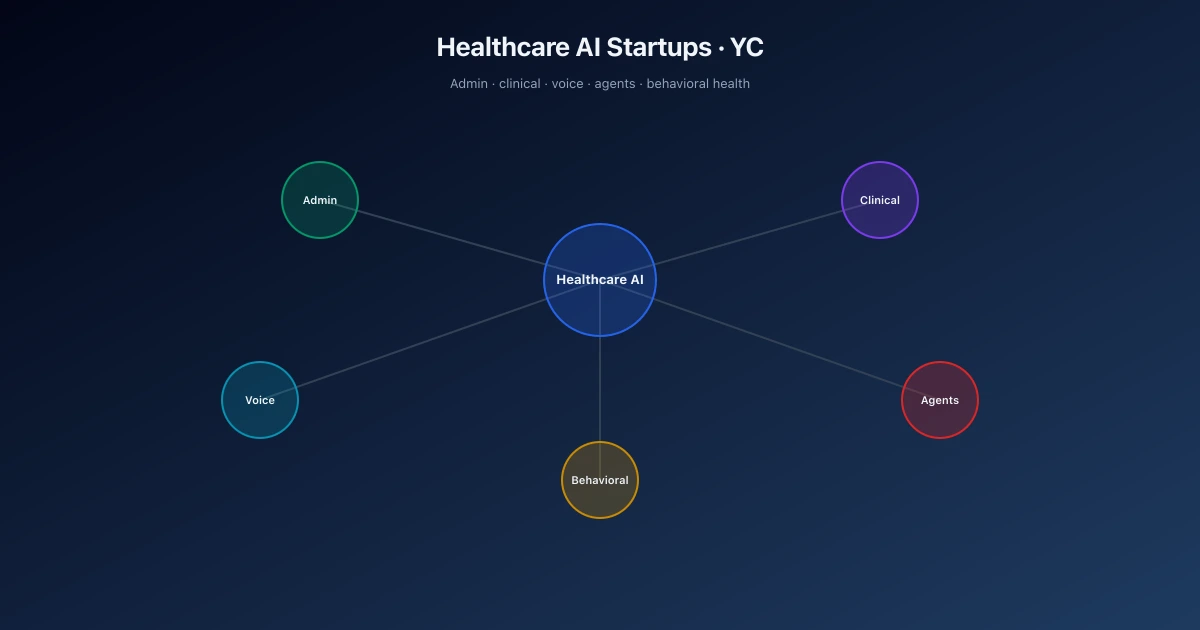
On Y Combinator's alumni base, healthcare AI is not one product type—it spans:
- Administrative automation — scheduling, credentialing, billing, prior auth
- Clinical augmentation — imaging, documentation, decision support (often FDA-touching)
- Conversational agents — voice and chat for patients and staff
- Behavioral health ops — clinic back office, compliance, care coordination
- Life sciences / R&D — trial design, drug discovery tooling
Browse healthcare and artificial intelligence on Guide Startups; this guide maps categories to real YC companies and what founders should know about regulation and sales cycles.
Healthcare AI Categories (With YC Examples)
| Category | Job to be done | Example YC companies |
|---|---|---|
| Admin & revenue cycle | Credentialing, billing, insurance verification | Harbera, Toothy AI, Cenote |
| Patient access & voice | Calls, scheduling, intake | Paratus Health, Patientdesk.ai |
| Clinical documentation | Notes, home health, nursing workflows | Andy AI |
| Imaging & diagnostics | Radiology, biopsy callbacks | Mecha Health, CopyCat |
| Healthcare AI agents | Orchestration across systems | Wedge |
| Behavioral health admin | Prior auth, compliance, clinic ops | Perspectives Health, Attunement |
| Ambulance / EMS | Field ops, billing, dispatch support | Amby Health |
| Clinical trials & R&D | Protocol design, computational biology | Delineate, Tamarind Bio |
Taglines and batches change; open each profile for founders, batch code, and descriptions. Recent concentration appears in W25 and S25 cohorts.
“Palantir for Healthcare AI Agents” Positioning
A recurring search pattern—"Palantir for healthcare AI agents" plus Y Combinator—maps to startups that unify data and deploy agents across hospital operations, not single-feature point tools.
Wedge (S25) describes itself as "Palantir for Healthcare AI Agents" in directory data: software that sits above fragmented EHR and ops systems so agents can act on consolidated context. This positioning signals:
- Platform ambition — multiple workflows, not one micro-SaaS feature
- Enterprise buyer — health systems and large provider groups
- Data integration moat — connectors and governance as defensibility
Investors and customers will compare you to prior "Palantir for X" claims—be specific about which workflows agents automate first (denials, staffing, supply chain) and what measurable ROI you deliver in 90 days. For AI positioning broadly, see how to position an AI-native SaaS company.
Behavioral Health and Clinic Operations
Behavioral health generates heavy admin load: prior authorization, documentation, compliance, and payer rules. YC companies target the clinic back office rather than replacing therapists.
- Perspectives Health (S25) — Automating admin for behavioral health clinics; matches high-volume searches around "Perspectives Health" and behavioral health automation.
- Attunement (W24) — Compliance automation for behavioral health, reducing clinician hours on paperwork.
- Clarion (W24) — AI communication layer for healthcare; cross-cutting patient and staff messaging.
These are vertical healthcare AI plays: deep workflow in one care setting beats generic chatbots. Sales often start with group practices or MSOs before health-system enterprise deals.
Voice AI, Patient Access, and Front-Desk Automation
Phone calls remain the front door for many practices. Voice AI startups handle scheduling, reminders, insurance questions, and after-hours triage.
- Paratus Health (W25) — Medical voice agents for patient management.
- Patientdesk.ai (W26) — AI voice agent for patient calls and admin workflows across practice management systems.
- Vocality Health (W25) — Voice AI for medical language translation.
Success metrics buyers care about: call deflection, no-show reduction, staff hours saved, and error rates on scheduling—not model benchmarks alone. HIPAA compliance and BAAs with customers are table stakes.
Clinical AI: Imaging, Documentation, and Diagnostics
Clinical healthcare AI touches patient care directly—higher regulatory scrutiny and longer validation cycles than admin tools.
- Mecha Health (W25) — Foundation models for x-ray analysis to assist radiologists.
- CopyCat (W25) — AI biopsy callback platform for dermatologists.
- Andy AI (W24) — Faster clinical documentation for home health nurses.
Founders should clarify FDA pathway (SaMD vs. clinical decision support exemption), liability, and hospital IRB or pilot requirements. Many start as physician-assist tools with human-in-the-loop rather than autonomous diagnosis.
EMS, Dental, and Other Vertical Wedges
Healthcare AI often wins through narrow wedges before expanding:
- Amby Health (W25) — AI copilot for ambulance agencies (EMS); field operations and billing complexity differ from clinic software.
- Toothy AI (W25) — Insurance verification and billing for dental clinics.
- careCycle (W25) — Voice AI teams for Medicare agencies.
Each wedge has distinct payers, regulations, and software stacks. Positioning as "healthcare AI" alone is weak; naming the care setting is strong. Compare with startup verticals vs. horizontal.
Regulation, HIPAA, and Enterprise Sales Cycles
Healthcare AI startups face constraints consumer AI apps do not:
- HIPAA and BAAs — Business associate agreements with covered entities; security reviews on data handling and subprocessors.
- FDA / clinical risk — Products that diagnose or treat may need regulatory clearance; document your intended use carefully.
- Procurement — Health systems run security questionnaires, legal review, and pilot committees—3–12 month cycles are common for enterprise.
- Liability and indemnity — Contracts allocate risk for AI errors affecting care or billing.
- Integration burden — EHR APIs (Epic, Cerner, etc.) and practice management systems dominate implementation time.
Admin automation startups often land faster than clinical AI because buyers frame ROI as labor savings, not clinical outcome trials. Still budget for compliance engineering early—not only after your first hospital logo.
How Healthcare AI Startups Go to Market
Repeatable GTM patterns among YC healthcare AI companies:
- Wedge workflow — One painful job (credentialing, prior auth, dental verification) with measurable hours saved.
- Pilot with expansion — Single clinic or service line → multi-site MSO → health system.
- Founder-led sales — Clinical or ops founders sell to peers; hire enterprise AEs after playbook exists.
- Integration partnerships — PMS/EHR vendors and billing companies as channel partners.
- Outcome-based pricing — Per-seat SaaS plus performance tied to denials reduced or calls handled.
For marketing fundamentals, see digital marketing strategies for startups; healthcare still rewards conferences, specialty associations, and warm intros over broad paid social.
How to Research Healthcare AI Companies on Guide Startups
- Start at /industries/healthcare and health-tech tags.
- Search /companies for keywords: "AI agent," "voice," "behavioral health," "credentialing."
- Open batch pages for recent AI-heavy cohorts: W25, S25, 2025.
- Read founders on how to find YC founders when diligencing teams.
- Cross-read industry spotlights guide and fintech verticals when companies blend health payments and admin.
Conclusion
Healthcare AI startups in Y Combinator cluster around admin automation, voice access, clinical augmentation, behavioral health ops, and agent platforms like Wedge. Search interest in "Palantir for healthcare AI agents" and named companies such as Perspectives Health reflects real buyer pain—not hype alone.
Pick a wedge with clear ROI, plan HIPAA and integration early, and study alumni on Guide Startups healthcare before you pitch investors or hospitals.
Frequently Asked Questions
What are healthcare AI startups?
Startups that use AI and automation for healthcare workflows—admin, clinical support, patient communication, life sciences R&D—with products sold to providers, payers, or life science companies.
Does Y Combinator fund healthcare AI companies?
Yes. Recent batches include Wedge (healthcare AI agents), Perspectives Health (behavioral health admin), Amby Health (EMS), Paratus Health (voice), and many W25 health-tech companies. Browse /industries/healthcare on Guide Startups.
What is Wedge Y Combinator?
Wedge (S25) is a YC company positioned as Palantir-style healthcare AI agents—integrating data and automating operations across health systems. See /companies/wedge-30668.
What does Perspectives Health do?
Perspectives Health (S25) automates administrative work for behavioral health clinics—prior auth, documentation, and clinic operations. See /companies/perspectives-health-30778.
How is healthcare AI different from general AI SaaS?
Healthcare requires HIPAA compliance, longer enterprise sales, EHR integration, and often FDA awareness for clinical features. Vertical workflow depth matters more than generic chat interfaces.
What regulations apply to healthcare AI startups?
HIPAA for protected health information, BAAs with customers, possible FDA oversight for clinical decision support or diagnostics, plus state privacy laws. Contracts address AI liability.
What is the best healthcare AI category for a new startup?
Admin and revenue-cycle automation often sell faster than autonomous clinical diagnosis. Choose a wedge where you have domain access and buyers measure ROI in labor hours or denial rates.
How do I find healthcare AI companies by YC batch?
Use /industries/healthcare, filter by batch at /batches/w25 or /year/2025, and search company descriptions for AI, voice, or agent keywords on /companies.
References
- Health Information Technology – U.S. HHS (HIPAA context)
- YC Healthcare Companies – Y Combinator
- Software as a Medical Device (SaMD) – U.S. FDA