Fintech Verticals: Sub-Sectors & YC Companies to Study
What Are Fintech Verticals?
Fintech verticals are specialized segments within financial services where software, data, or platforms replace or augment banks, insurers, payment networks, and back-office operations [1]. If you searched "fintech verticals," you are usually mapping sub-markets—not asking whether a company is "in finance" broadly.
Fintech sits at the intersection of regulation, money movement, and trust. A single startup often spans two sub-verticals (e.g. payments + compliance). YC tags companies with tags like fintech, payments, neobank, and regtech; browse the full set on /industries/fintech.
This guide breaks down major fintech verticals, names Y Combinator companies worth studying in each, and covers what founders and investors weigh before building or backing a fintech wedge. For general vertical terminology, see what are industry verticals; for vertical vs. horizontal strategy, read startup verticals vs. horizontal.
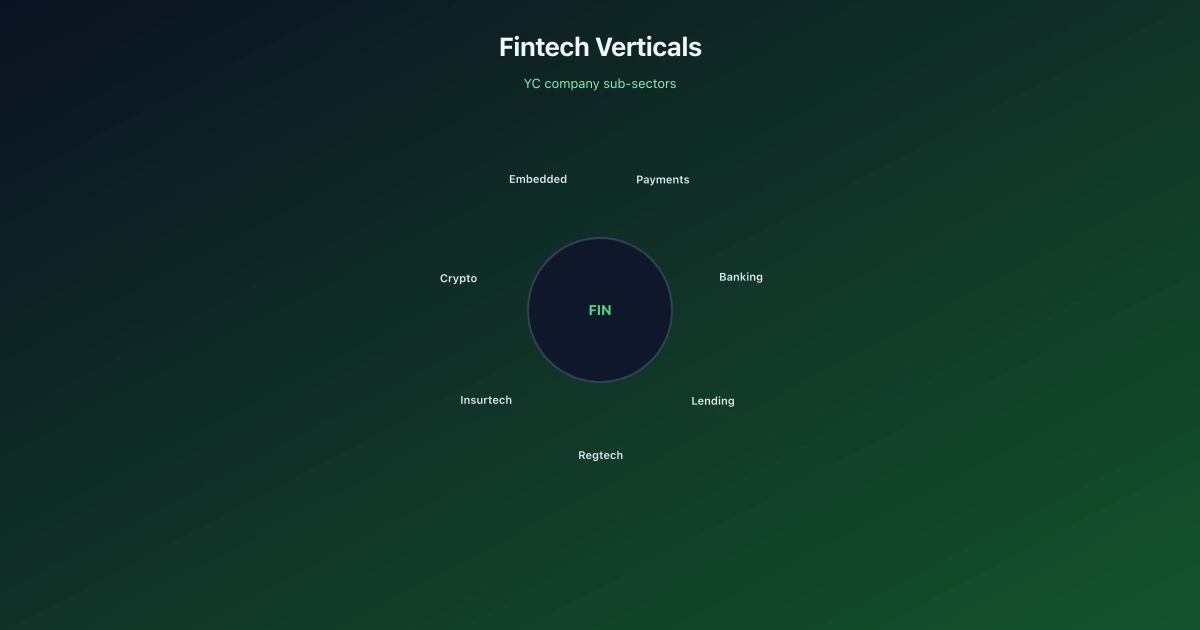
Fintech Sub-Vertical Map
| Sub-vertical | What startups build | Typical buyers |
|---|---|---|
| Payments & money movement | Checkout, payouts, stablecoin rails, treasury APIs | Merchants, platforms, marketplaces |
| Banking & neobanking | Business accounts, consumer neobanks, BaaS wrappers | SMBs, consumers, startups |
| Lending & credit | Underwriting, BNPL, fleet finance, revenue-based products | Consumers, SMBs, vertical niches |
| Embedded finance | Finance inside vertical SaaS (insurance, payroll, invoicing) | Software platforms embedding financial products |
| Capital markets & infra | Brokerage back office, settlement, trading tools | Brokers, funds, fintech platforms |
| Insurtech | Distribution, underwriting automation, claims | Carriers, brokers, employers |
| Regtech & compliance | KYC/AML, policy monitoring, audit automation | Banks, fintechs, regulated enterprises |
| Crypto / Web3 finance | On-ramps, stablecoins, DeFi interfaces, custody | Developers, traders, emerging markets |
Guide Startups lists hundreds of fintech-tagged alumni; counts shift each batch. Use /year/2025 and /batches/w25 to see how recent cohorts cluster.
Payments, Treasury, and Money Movement
The payments vertical is YC's most visible fintech success lane—economic infrastructure that other companies plug into.
- Stripe (S09) — API-first payments and financial infrastructure for the internet; the canonical horizontal fintech platform.
- Modern Treasury (S18) — Payment operations and money-movement tooling for companies that need ledger-grade controls.
- BlindPay (W25) — Stablecoin API for global payments; represents newer rail diversity beyond card networks.
Startups here compete on reliability, developer experience, geographic coverage, and unit economics on volume. Embedded checkout inside vertical SaaS is a common wedge—payments as the first financial product before expanding to banking or lending.
Banking, Neobanking, and Startup Finance
Neobanking verticals target consumers or businesses underserved by legacy banks—or bundle finance with software buyers already use.
- Brex (W17) — Corporate cards and spend management for startups and modern companies.
- Arc (W22) — Banking and funding tailored to startups.
- Karoo (W25) — Canadian neobank focused on lending.
- Karsa (W25) — Stablecoin neobank for emerging markets.
These companies often partner with licensed banks (BaaS) rather than holding charters on day one. Regulatory structure and interchange economics shape GTM as much as UX.
Lending, Credit, and Vertical Finance
Lending fintech verticals embed credit where cash-flow data is visible—fleet operations, marketplaces, payroll, or invoicing.
- Rally (W25) — Financial OS for modern fleets; vertical finance tied to transportation ops.
- The New Money Company (W24) — Invoicing with payment guarantees; working-capital angle for B2B.
Underwriting quality and cost of capital separate winners from BNPL burnout. Vertical lenders often start with a non-lending software wedge, then add credit once they hold repayment data—a pattern investors recognize from earlier YC alumni cycles.
Insurtech and Risk
Insurtech verticals automate brokerage, underwriting, or claims—often with AI replacing manual document work.
- Harper (W25) — AI-native commercial insurance brokerage.
- Cardamon (W25) — AI compliance for regulated financial businesses; fintech meets insurance and policy workflows.
Sales cycles mirror insurance distribution: brokers, carriers, and employers each need different SKUs. Regulatory licensing varies by product (MGA, agency, carrier partnership).
Regtech, Compliance, and B2B Fintech Ops
Regtech sells into banks and fintechs that must prove compliance continuously—not only at audit time.
- Cardamon (W25) — AI compliance co-pilot for regulated financial businesses.
- Tejas AI (W25) — Risk decisioning platform for banks.
- GoldenBasis (W24) — Back-office software for brokerages.
These verticals win on accuracy, audit trails, and integration into core banking stacks. Budget often comes from risk/compliance lines, not innovation labs—plan enterprise sales accordingly.
Crypto, Stablecoins, and Emerging-Market Fintech
Crypto/Web3 fintech verticals at YC range from trading interfaces to stablecoin rails for cross-border money movement.
- Coinbase (S12) — Consumer and institutional crypto exchange; landmark YC fintech outcome.
- BlindPay and Karsa (W25) — Stablecoin payments and neobanking for markets where legacy rails are slow or expensive.
Regulatory clarity varies by jurisdiction; emerging-market fintech often leapfrogs card infrastructure with mobile money and stablecoins. Tag overlap with crypto/Web3 is common on company profiles.
Investor and Regulatory Considerations by Vertical
Fintech verticals share themes investors diligence heavily:
- Licensing path: Partner bank vs. own charter vs. non-licensed software vendor.
- Unit economics: Interchange, spread, SaaS fee, or hybrid; payback on CAC in regulated sales.
- Fraud and credit loss: Especially in lending and consumer neobanking.
- Geography: US/EU compliance differs from LatAm, Africa, and Southeast Asia wedges.
- Platform risk: Dependence on Visa, Apple Pay, or a single sponsor bank.
Founders raising pre-seed should align milestones with their sub-vertical—payments startups prove volume and reliability; regtech proves audit outcomes. See pre-seed funding for startups and best industries for startups in 2025 for sector context.
How to Research Fintech Companies on Guide Startups
- Open /industries/fintech for the full fintech alumni list.
- Cross-filter mentally by tags on each profile: payments, neobank, lending, regtech, insurance.
- Compare batch eras—S09 (Stripe era) vs. W25 (AI + stablecoin wave).
- Read founder backgrounds on /founders for domain expertise signals.
- Use browse guide for search and ID lookup patterns.
For strategic framing of vertical depth, pair this list with industry spotlights guide.
Conclusion
Fintech verticals span payments, banking, lending, embedded finance, insurtech, regtech, and crypto—each with distinct buyers, regulation, and economics. Y Combinator's alumni map shows horizontal infra winners like Stripe alongside vertical wedges like fleet finance and AI compliance copilots.
Start from fintech on Guide Startups, study company profiles by sub-vertical, and read vertical vs. horizontal strategy before you pitch investors.
Frequently Asked Questions
What are fintech verticals?
Fintech verticals are specialized segments within financial technology—such as payments, neobanking, lending, insurtech, regtech, and crypto—each with distinct products, regulation, and buyers.
What fintech sub-sectors does Y Combinator fund?
YC has backed payments infra (Stripe), corporate spend (Brex), global payroll (Deel), crypto (Coinbase), and recent wedges in stablecoins, AI compliance, fleet finance, and neobanking. Browse /industries/fintech for the full list.
What is the difference between fintech and embedded finance?
Fintech is the broad category; embedded finance means financial products (payments, lending, insurance) delivered inside non-finance software—often a vertical SaaS company's second monetization layer.
Is regtech a fintech vertical?
Yes. Regtech sells compliance, KYC/AML, and risk tooling to banks and fintechs. It is B2B software with regulatory outcomes rather than consumer-facing finance.
How do I find YC fintech companies by batch?
Use /industries/fintech, then open batch pages like /batches/w25, or filter by year at /year/2025 on Guide Startups.
What regulations matter for fintech startups?
Depends on sub-vertical: money transmission, lending licenses, broker-dealer rules, insurance distribution, and KYC/AML for most customer-facing products. Most early YC fintechs partner with licensed institutions.
Are crypto startups a fintech vertical?
Yes, though often tagged separately as crypto/Web3. Overlap is growing as stablecoin payments and on-ramps blur lines with traditional payments.
What is the best fintech vertical for new founders?
There is no universal best choice—match sub-vertical to your domain insight and distribution. Vertical wedges with visible workflow pain often beat generic neobank pitches at seed stage.
References
- YC Fintech Companies – Y Combinator
- Requests for Startups – Y Combinator sector themes