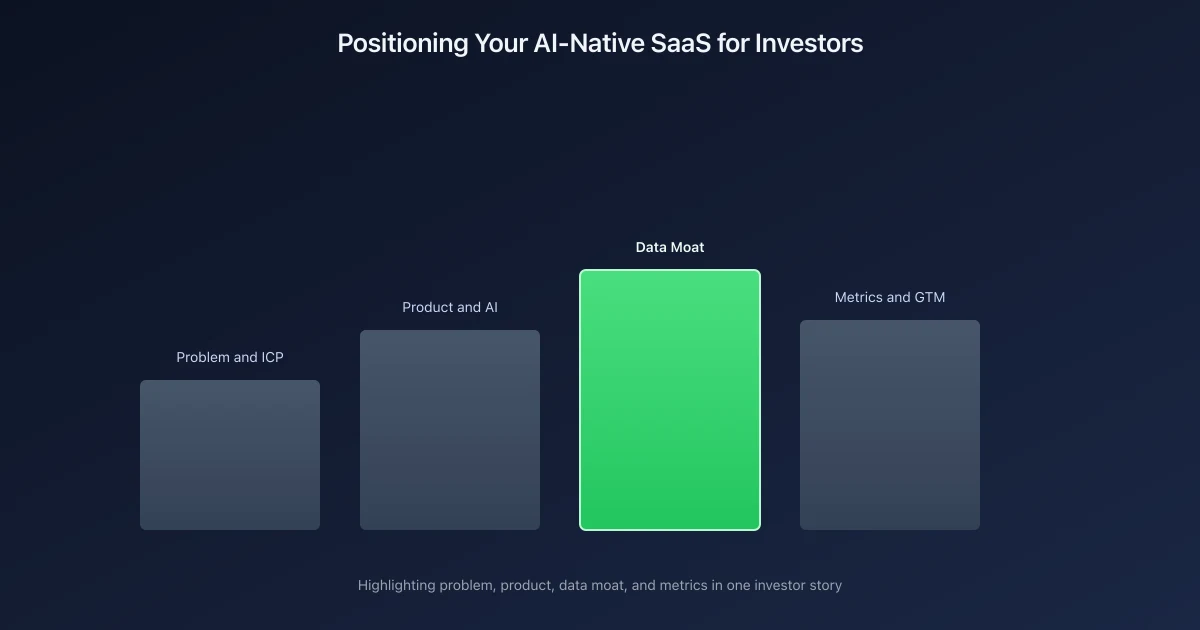
How to Position an AI-Native SaaS Company for Investors
What “AI-Native SaaS” Really Means to Investors
“AI-native” is used so often that investors are skeptical by default. For many decks, it just means a traditional SaaS product with a model bolted on. When investors say they want AI-native SaaS, they mean companies where AI is the foundation of the product and business model – not a feature you could rip out without changing much.
Practically, AI-native SaaS usually looks like this:
- AI sits in the critical path of the workflow, not as a sidecar tool.
- The company is building data loops and feedback systems that continuously improve the product.
- The product delivers step-change outcomes (10x better, faster, or cheaper) compared to non-AI alternatives – not just nicer UX.
- The team behaves like an AI company: fast shipping, model evaluation discipline, and deep understanding of infrastructure trade-offs.
Positioning your company for investors starts with telling the truth about which of these you already have – and which you are on the path to building.
Start With the Foundation: Problem, Customer, and Use Case
Even for AI-native products, investors still care most about who you serve and what problem you solve. Many AI decks jump straight into architecture and model choices and never land a clear use case.
Clarify the Pain and Buyer
Define a specific, high-value problem and a specific buyer. For example: “We automate level‑1 support triage for B2B SaaS companies” or “We remove 80% of manual underwriting work for mid-market commercial insurers.” This anchors your AI story in a business context.
Show Why AI Is the Right Tool
Explain why the problem is uniquely suited to AI-native approaches: messy unstructured data, patterns too complex for rules, or continuous learning from user behavior. If a simple rules engine could do the job, you have to justify why AI is the better, more durable solution.
Connect Use Case to Budget and Priority
Investors want to know where the budget comes from and why your category is a priority. Position your product next to existing line-items (e.g. headcount, legacy tools) you can replace or augment with clear ROI.
Crafting Your AI-Native Product and Moat Story
Once the business problem is clear, explain how AI makes your product uniquely defensible. Investors know that features can be cloned quickly in the age of AI-assisted development. They are looking for durable moats.
Models: What You Use vs What You Own
Be honest about your stack. Using foundation models from OpenAI, Anthropic, or others is normal. What matters is how you:
- Fine-tune or adapt models for your specific domain.
- Inject domain knowledge via retrieval, tools, and workflow context.
- Evaluate model performance continuously (accuracy, latency, safety).
Position this as a system you are building, not just a choice of vendor.
Data: Your Primary AI Moat
Strong AI-native positioning focuses on your data advantage. Investors want to see:
- Access to unique data competitors cannot easily scrape or buy.
- Data loops where usage improves the model (better suggestions, fewer errors, more automation) and better performance attracts more users.
- Clear policies for governance, privacy, and compliance, especially in regulated industries.
Describe your data flywheel in simple terms: who provides the data, how you clean and label it, how it improves the system, and how that improvement feeds back into customer value.
Workflow Depth and “System of Record” Ambition
Investors are drawn to AI-native products that sit deep in a workflow instead of staying at the surface as a helper. If your product becomes a system of record or an indispensable system of engagement, it captures proprietary workflow data over time and becomes very hard to rip out. Make this ambition explicit in your positioning.
SaaS Metrics and Traction Story for AI Companies
AI-native or not, venture investors still rely on core SaaS metrics – they just interpret them with nuance.
Show Real, Not Just Novel, Usage
Top-of-funnel experiments and viral demos are less convincing now. Emphasize:
- Active usage and retention for your core workflows.
- Customers running your AI in production, not just pilots.
- “Before vs after” improvements in time, accuracy, or cost.
Highlight a few concrete customer stories with real numbers, not just logos.
Connect AI to Unit Economics
Explain how AI improves or at least sustains your unit economics:
- Does AI reduce marginal delivery cost per workflow?
- Does it increase expansion potential (higher ACV via automation)?
- Does it make onboarding cheaper through self-serve flows or embedded guidance?
Traditional metrics still matter – ARR growth, net revenue retention, churn, CAC/LTV – but for very early-stage companies you can use strong leading indicators (engagement, expansion from design partners, willingness to pay) to show you are on track.
Be Transparent About Model and Infra Costs
Model and infrastructure spend can crush margins if they are ignored. Investors will ask:
- How much does it cost to serve an average customer or workflow?
- Where do you see leverage in the next 12–24 months (better caching, smaller models, custom infra)?
Position your company as disciplined about cost and model choice, not just chasing the newest API.
Go-to-Market and Adoption Narrative
Many AI-native SaaS products fail not because of models, but because the go-to-market story is fuzzy. Investors want to understand how your product spreads.
Who Buys and Who Uses
Clearly separate the economic buyer (who signs) from the users (who touch the product daily). A strong AI positioning shows why both groups win: buyers get ROI and risk reduction; users get better, faster workflows rather than more work.
Land-and-Expand Strategy
Describe your wedge: the first problem, team, or department where you win. Then show how usage expands across workflows, teams, or geographies. If AI lets you start small (e.g. one team, one workflow) and expand quickly, say so explicitly.
Why Now?
Answer the timing question: what changed in data availability, model capabilities, or customer behavior that makes your product possible or urgent now? AI funding cycles move quickly; a crisp “why now” increases investor confidence.
An Investor-Ready Positioning Framework
Bringing these pieces together, you can structure your investor positioning as a simple, repeatable framework.
1. Problem and Customer
One or two sentences on who you serve and what mission-critical problem you solve.
2. AI-Native Solution
How your product uses AI in the critical path of the workflow and why AI is the right tool for this problem.
3. Data and Workflow Moat
Your data sources, feedback loops, and long-term defensibility. How usage improves the product and locks in customers over time.
4. Traction and Economics
Key metrics, case studies, and early economics that show real value and a path to strong margins.
5. Go-to-Market and Why Now
Who buys, how you reach them, how usage expands, and what changed to make this opportunity compelling at this moment.
Use this spine to organize your deck and narrative. Repetition across docs, calls, and emails reinforces the positioning in investors’ minds.
Common Positioning Mistakes AI Founders Make
Investors have seen many AI-native pitches. Some patterns consistently worry them.
Leading with architecture instead of problem. Deep model details without a clear use case suggest research, not a business.
Claiming a moat that is really a feature. UI, prompts, or light fine-tuning are not durable on their own. Connect your moat story to data, workflow depth, or distribution.
Ignoring costs and reliability. Overpromising automation without acknowledging failure modes and infra costs undermines credibility.
Being vague about customers. “Any knowledge worker” is not a segment. The narrower and clearer your initial target, the stronger your positioning usually feels.
Overusing buzzwords. Terms like “agents,” “copilots,” and “AI OS” without specifics read as hype. Replace them with concrete descriptions of what the product does.
Conclusion
Positioning an AI-native SaaS company for investors means more than saying you use AI. It means clearly articulating the problem and buyer, showing how AI is in the critical path of the workflow, demonstrating a data and workflow moat that compounds over time, and connecting your product to real traction and disciplined economics.
Used well, this positioning becomes a lens for product and go-to-market decisions, not just a fundraising story. As you refine it, keep talking to customers, measuring outcomes, and updating your narrative based on what actually works in the field – that is the signal investors trust most.
Frequently Asked Questions
What does “AI-native SaaS” really mean to investors?
Investors use AI-native to describe companies where AI is core to the product and business model, not just a feature. They look for products with AI in the critical path of workflows, strong data feedback loops, and a team that treats model quality, evaluation, and infra choices as first-class concerns.
How do I show I have a data moat?
Explain what data you collect that others cannot easily access, how you clean and label it, and how it improves your models and user outcomes over time. Show concrete examples of the product getting better as usage increases and emphasize how this flywheel makes it hard for competitors to catch up.
What metrics matter most for AI-native SaaS?
Core SaaS metrics still matter: ARR growth, net revenue retention, churn, and CAC/LTV. For earlier stages, investors also watch active usage, retention on key workflows, willingness to pay, and improvements in cost or time for your customers. Be transparent about model and infra costs and how you expect them to evolve.
Should I go broad or niche with my positioning?
Early on, narrower is usually stronger. A specific vertical or workflow makes it easier to build deep product value and proprietary data. Once you have real traction and a clear wedge, you can expand your narrative to adjacent use cases or segments.
How do I balance technical and business detail in my pitch?
Lead with the business problem and customer, then explain just enough about the AI system to make your moat and execution credible. Deep technical detail belongs in follow-up sessions and diligence. In the first conversation, clarity beats complexity.
How can I avoid sounding like an “AI wrapper” company?
Anchor your story in specific workflows, outcomes, and data loops, not just in which model you use. Show that removing AI would fundamentally break the product, and that your advantage grows with usage and time – not just with access to the same APIs everyone else uses.
References
- Mastering product-market fit: A playbook for AI founders – Bessemer Venture Partners
- Building and scaling an AI company in 2025 – SaaStr
- Where’s the moat in AI? – Glasswing Ventures
- What AI-focused VCs are looking for – Snowflake