Raising Series A After Y Combinator: Timeline & Metrics
The Post-YC Fundraising Ladder
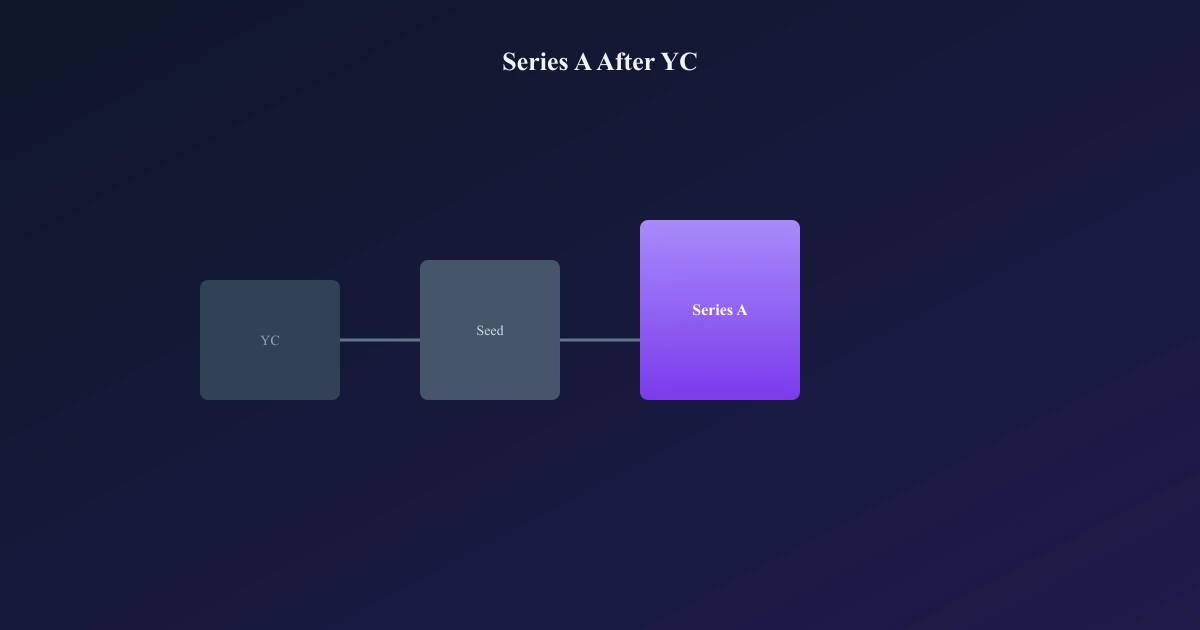
Y Combinator sits early in the startup funding ladder. Accepted founders receive the $500K standard deal (details here)—that is not Series A. Most alumni sequence:
- YC investment — at acceptance (SAFEs + program).
- Seed / pre-seed extensions — around Demo Day and the 6–18 months after.
- Series A — priced round when growth and retention justify institutional scale-up capital.
If you searched "raising Series A after Y Combinator" or "raising Series A funding startup," you are planning the transition from accelerator-backed seed to a $2M–$15M+ priced round (amounts vary by market and sector).
Typical Timeline: Demo Day to Series A
| Phase | Timing | Focus |
|---|---|---|
| Demo Day | End of batch (~month 3) | Seed conversations, angels, seed funds |
| 0–6 months post-Demo Day | Seed close, ship, iterate | Metrics, hiring, GTM repeatability |
| 6–18 months post-Demo Day | Series A prep | ARR/usage growth, retention, sales efficiency |
| Series A process | Often 2–4 months | Data room, partner meetings, term sheet |
Fast movers in hot sectors close Series A within a year; enterprise or regulated verticals often take longer. Batch calendar: YC batch schedule; program length: how long is Y Combinator.
Metrics Investors Expect at Series A (2025–2026)
Series A bars rose after 2021. No single threshold applies to every sector, but investors commonly evaluate:
- Revenue / ARR — often $1M–$3M+ ARR for B2B SaaS in strong markets (lower for exceptional growth or strategic categories).
- Growth rate — month-over-month or year-over-year; deceleration without a story hurts.
- Retention — net revenue retention (NRR) or logo retention for SMB; cohort curves for consumer.
- Unit economics — CAC payback, gross margin, path to profitability.
- Market size — credible expansion from wedge to platform.
Pre-revenue deep-tech may raise on technical milestones instead—still the exception. Baseline funding concepts: how to raise Series A funding and pre-seed funding.
How YC Alumni Differ in Series A Conversations
YC affiliation affects access, not automatic valuation:
- Warm intros — alumni network, Demo Day investors, Bookface (for founders).
- Brand shortcut — partners may take a first meeting faster; you still must prove metrics.
- Comparables — investors benchmark against other YC companies in your batch and vertical on directories like Guide Startups.
- Standard deal overhang — understand dilution from YC SAFEs before modeling Series A ownership.
Study peers in your batch and industry: /batches + /industries. See who raised next by following press and job postings—not all directory data includes round size.
Warm Intros and Investor Targeting After YC
Build a tiered list:
- Investors who engaged at Demo Day or seed.
- Funds with explicit YC alumni portfolios or batch funds.
- Vertical specialists (fintech, healthcare AI) matching your tags.
- Strategic corporates in your industry.
Intro hygiene: forwardable blurb, one chart on metrics, clear ask (15-minute meeting). Alumni intros work best when the introducer knows your traction—not only that you did YC.
Accredited angel strategies before institutional A: attract accredited investors without a marketing agency.
Seed vs. Series A: Don't Skip the Middle
Some teams treat YC as full capital through Series A—it rarely is. The $500K deal extends runway but Series A typically requires a seed narrative with lead investor, cap table cleanup, and 12–18 months of post-Demo Day proof.
Common seed milestones before A:
- Repeatable acquisition channel
- Core team hired (eng + GTM)
- Product beyond MVP—retention visible
- Legal/cap table ready for priced round
Common Mistakes Raising Series A After YC
- Fundraising too early — one good Demo Day week is not Series A readiness.
- Fundraising too late — sub-6 months runway weakens term sheets.
- Ignoring seed cap table — messy SAFE stacks slow priced rounds.
- Vertical vagueness — investors need ICP and expansion logic; see industry verticals.
- Comparing to 2021 outliers — use current market comps from your sector.
- Underusing alumni — intros without prep waste social capital.
Conclusion
Raising Series A after Y Combinator usually means 12–24 months post-Demo Day with seed traction, strong retention, and targeted outreach through alumni and sector funds. YC opens doors; metrics close the round.
Read Series A funding guide, explore YC alumni in your vertical, and map your batch peers on /batches for comparables.
Frequently Asked Questions
When do YC companies raise Series A?
Often 12–24 months after Demo Day, after seed traction and metrics that justify a priced round. Timing varies by sector and market conditions.
Does YC investment count as Series A?
No. YC's $500K standard deal is accelerator funding on SAFEs, not a Series A priced round.
What ARR do you need for Series A after YC?
Many B2B SaaS companies target roughly $1M–$3M+ ARR with strong growth, but exceptional teams raise on less in hot categories. Investors weigh growth and retention together.
How does Demo Day help Series A?
Demo Day concentrates seed investor attention. Series A later uses those relationships plus new growth-stage funds—not Demo Day itself.
Can you raise Series A without seed after YC?
Uncommon. Most teams close seed or extend runway after YC before a priced Series A.
How do I find YC companies that raised Series A?
Research batch peers on Guide Startups, follow funding news, and compare verticals on /industries—not all round data is on company pages.
References
- The Y Combinator Standard Deal – Y Combinator