What Y Combinator Gives Accepted Founders: Deal & Benefits
What Accepted YC Founders Receive: The Full Package
If you searched "what does Y Combinator give founders," "what do Y Combinator batch winners get," or "what does the Y Combinator winter batch winners get," the answer has two parts: capital on standard terms and program resources that continue after Demo Day.
Every accepted company receives the same $500,000 standard deal—no negotiation, no special terms for one batch over another [1]. On top of that check, founders get a three-month accelerator program, partner office hours, batch community, investor introductions at Demo Day, and lifetime access to the YC alumni network.
YC invests the day you are accepted, not when the batch officially starts. That timing matters for founders who need runway immediately. For how long the program runs after funding, see how long is Y Combinator.
The $500,000 Standard Deal Explained
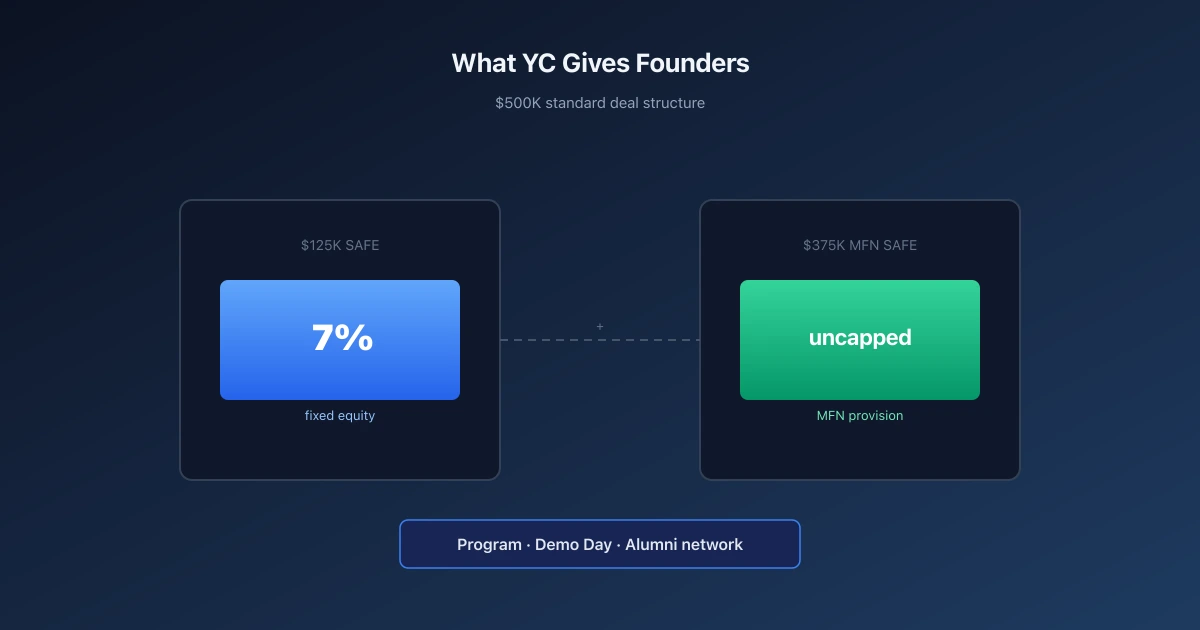
YC's current standard deal is $500,000 total, split across two SAFE instruments signed at acceptance [1][2]:
| Instrument | Amount | Terms | When it converts |
|---|---|---|---|
| $125K post-money SAFE | $125,000 | Fixed 7% equity | Your next priced equity round |
| MFN uncapped SAFE | $375,000 | Uncapped with Most Favored Nation clause | Next priced round, on best SAFE terms you grant other investors |
There is no milestone gating—the investment is committed when you are accepted. YC also receives a participation right in future financings through the YC Agreement, which helps YC maintain its ownership stake as you raise larger rounds [1].
This structure replaced the older $150K for 7% model. The extra capital is designed to give founders more runway before seed fundraising pressure kicks in [2].
How the $125K SAFE at 7% Works
The first $125,000 is on a post-money SAFE that converts into exactly 7% of your company at your next priced round, regardless of the valuation you negotiate with future investors [1].
Post-money means the 7% is calculated after all SAFEs and convertible notes convert alongside the priced round—not before. For founders, the key takeaway is predictability: you know YC will own 7% from this tranche before you talk to seed investors.
Example: if you raise a seed round at a $10M post-money valuation, the $125K SAFE still converts to 7% (subject to the standard SAFE conversion mechanics and any option pool expansion in that round). Founders who want a deeper walkthrough of dilution should consult a startup attorney before signing; YC publishes standard document templates used across the ecosystem.
How the $375K MFN Uncapped SAFE Works
The second $375,000 is on an uncapped SAFE with a Most Favored Nation (MFN) provision [1][2]. Uncapped means no valuation cap is set at signing. Instead, the SAFE converts at the terms of your next priced round—or adopts the most favorable SAFE terms (lowest cap, best discount) you grant to other investors between batch start and that round.
Why MFN exists: YC invests early without negotiating a cap, but protects itself from giving you better terms than it receives. If you later issue a SAFE at a $8M cap to a seed fund, YC's $375K tranche converts on those same favorable terms.
Founder implication: the effective dilution from the $375K piece depends on how well you negotiate your seed round. A higher seed valuation means less additional dilution from this tranche. If you are still at the pre-seed stage before applying, our guide on pre-seed funding for startups explains how SAFEs fit into the broader ladder.
Program Benefits Beyond the Investment
Money is only part of what Y Combinator batch winners get. The three-month program includes:
- Partner office hours. Weekly meetings with YC partners who have built or funded companies at scale. Partners push on product, growth, hiring, and fundraising strategy.
- Batch kickoff and community. You join a cohort of founders going through the same sprint. Peer accountability and informal help are often cited as underrated benefits.
- Group office hours and events. Talks, dinners, and themed sessions on topics like pricing, sales, and hiring early employees.
- Launch support. YC encourages shipping during the batch. Launch YC and batch visibility can drive early users and press.
- Bookface. YC's private founder forum for asking questions, finding intros, and hiring from the alumni network.
- Deals and credits. YC publishes a benefits package (cloud credits, software discounts, banking partners) that reduces early burn [3].
Program structure is roughly the same for Winter, Spring, Summer, and Fall batches. Calendar timing differs; the deal and support do not. See Y Combinator batch schedule for season-specific dates.
Demo Day and Investor Access
Each batch culminates in Demo Day, where companies present to a large audience of investors. For 2026, official Demo Day dates are March 24 (Winter), June 16 (Spring), September 10 (Summer), and December 2 (Fall) [4].
Demo Day is not the only fundraising moment—many teams raise before, during, and long after—but it concentrates investor attention on your batch. YC's brand and the batch format create a warm-intro environment that is difficult to replicate as a solo founder cold-emailing VCs.
After Demo Day, fundraising timelines vary. Some companies close seed rounds within weeks; others continue building and raise later. For what typically happens next, read how to raise Series A funding once you have seed traction.
Alumni Network and Ongoing Support
YC positions itself as a lifetime community, not a three-month course. Alumni retain access to Bookface, can attend alumni events, and often help each other with hiring, customer intros, and later-round fundraising.
The alumni network scales with every batch—thousands of companies across industries and geographies. When founders ask what YC "batch winners" get long-term, this network is frequently the answer that compounds over years, not just the initial $500K.
You can study what alumni built by browsing YC companies on Guide Startups, filtering by batch, year, or industry to see patterns in your vertical.
What Y Combinator Does Not Give You
Setting expectations clearly helps founders evaluate fit:
- No guaranteed follow-on funding. YC invests the standard deal; seed and Series A depend on your metrics and market.
- No custom deal terms. Every company gets the same structure. You cannot negotiate a higher amount or lower equity percentage.
- No deferred admission to a later batch. If accepted, you join the upcoming batch (Early Decision for students is a separate application path—see how to apply to Y Combinator).
- No replacement for product-market fit. The program accelerates founders who execute; it does not automatically create traction.
- Not a co-founder matching service. YC expects a committed team at application time, though solo founders are sometimes accepted.
Understanding these limits helps you compare YC against angels, pre-seed funds, or other accelerators on total value, not just headline check size.
How YC Benefits Compare to Other Accelerators
Most accelerators offer a combination of capital, mentorship, and demo events. YC differentiates on:
| Factor | Y Combinator | Typical accelerator |
|---|---|---|
| Standard deal size | $500K (fixed terms) | Often $100K–$250K, negotiable |
| Equity | 7% + MFN SAFE conversion | Varies (5–10% common) |
| Batch frequency | Four per year | One to two per year |
| Investor network | Global Demo Day + alumni | Regional or sector-specific |
| Program length | ~3 months | 3–6 months typical |
Whether YC is the right fit depends on stage, sector, and how much you value the alumni brand versus local ecosystem ties. Use startup ecosystem explained for broader context on accelerators versus angels and VCs.
Conclusion
What Y Combinator gives accepted founders is $500,000 on standard terms—$125K for 7% plus a $375K MFN uncapped SAFE—plus a three-month program, Demo Day investor access, software credits, and lifetime alumni community. Every batch winner receives the same deal; Winter, Spring, Summer, and Fall differ only in calendar timing.
Confirm current terms on ycombinator.com/deal, explore alumni on Guide Startups, and read how to apply to Y Combinator if you are preparing an application.
Frequently Asked Questions
What does Y Combinator give batch winners?
Accepted companies receive $500,000 on standard terms ($125K post-money SAFE for 7% equity plus a $375K uncapped MFN SAFE), access to the three-month YC program, Demo Day, software credits, and lifetime alumni network access through Bookface.
How much equity does Y Combinator take?
The $125K SAFE converts to a fixed 7% at your next priced round. The $375K MFN SAFE converts on the best terms you grant other SAFE investors before that round, so total dilution depends on your seed negotiation.
Do all YC batches get the same deal?
Yes. Winter, Spring, Summer, and Fall companies all receive the identical $500K standard deal. There is no negotiation on amount or structure.
When does YC send the money?
YC commits to invest the day you are accepted and begins the funding process immediately—it is not contingent on batch start or milestones [1].
What is the MFN SAFE?
MFN (Most Favored Nation) means YC's $375K uncapped SAFE adopts the most favorable terms—such as the lowest valuation cap—you give to other convertible investors between batch start and your next priced round.
Is Demo Day included for every accepted company?
Yes. Each batch ends with Demo Day, where companies present to investors. Dates are published annually on YC's blog.
What resources do YC founders get after the batch?
Alumni keep Bookface access, can attend alumni events, and benefit from the broader YC network for hiring, customer intros, and later fundraising. Support continues beyond the three-month program.
Does YC guarantee seed funding after Demo Day?
No. Demo Day creates investor access, but closing a seed round depends on your traction, market, and execution. Many alumni raise successfully; others continue building before fundraising.
References
- The Y Combinator Standard Deal – Y Combinator
- YC's $500,000 Standard Deal – Y Combinator
- YC Deals for Founders – Y Combinator
- 2026 Demo Day Dates – Y Combinator